Weekly Coaching Tip: 12 Tips for Coping with Uncertainty


[Throughout the first half of 2026, I hope to provide you with a robust picture of how existential wellness coaches work with their clients on fundamental existential issues. If you’d like to learn more about the Noble-Manhattan Existential Wellness Coaching Certificate Program that I’ve developed, please visit here. There are scholarships available and all of the resources of the Noble Manhattan family. Come take a look. Today’s offering is Part 8 of a mini-series on ambiguity and uncertainty, two issues with which your clients are unquestionably wrestling.]
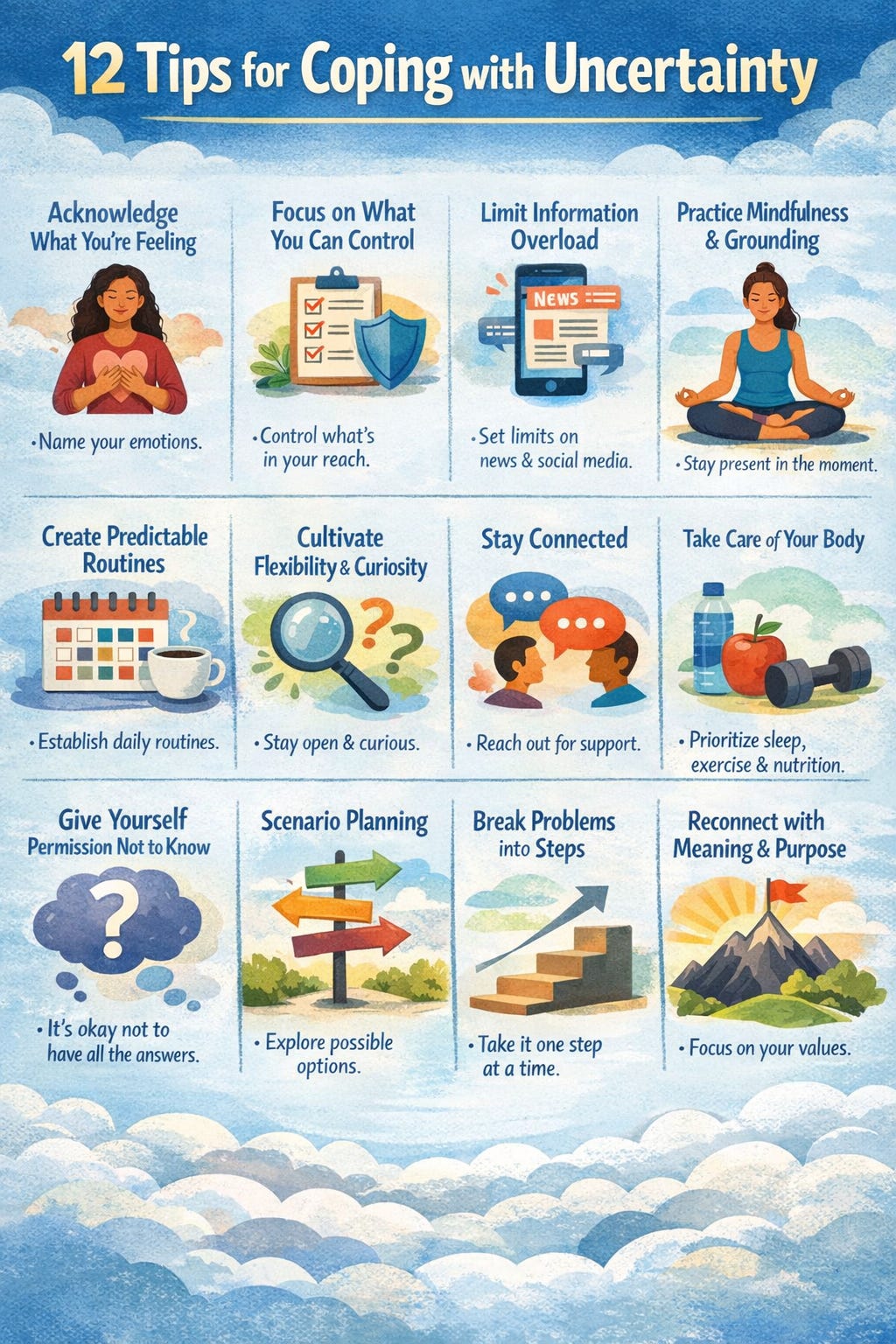
Uncertainty is woven into the fabric of life. Whether it’s related to health, work, relationships, or global events, the unknown can trigger anxiety and restlessness. While we can’t eliminate uncertainty, we can change how we relate to it. These ten tips offer practical ways to cope more effectively with the unpredictable nature of life. You might offer this list to clients for whom “uncertainty” is an issue.
1. Acknowledge What You’re Feeling
The first step in coping with uncertainty is simply naming your emotions. Anxiety, frustration, helplessness, or even grief may surface. Suppressing or denying these feelings only intensifies them. Instead, try saying to yourself: “This is hard, and I feel anxious—and that’s okay.” Naming the feeling often takes away some of its power.
2. Focus on What You Can Control
When the big picture is unclear, shift your focus to what’s within your sphere of influence. You can’t control the economy, but you can manage your spending. You can’t control someone else’s choices, but you can set your boundaries. Making small, grounded decisions helps restore a sense of agency.
3. Limit Information Overload
Endless scrolling for news or updates rarely calms uncertainty—in fact, it often amplifies it. Decide how much and when you’ll check news or social media, and stick to it. Curate your sources to include trustworthy, balanced information rather than sensationalism.
4. Practice Mindfulness and Grounding
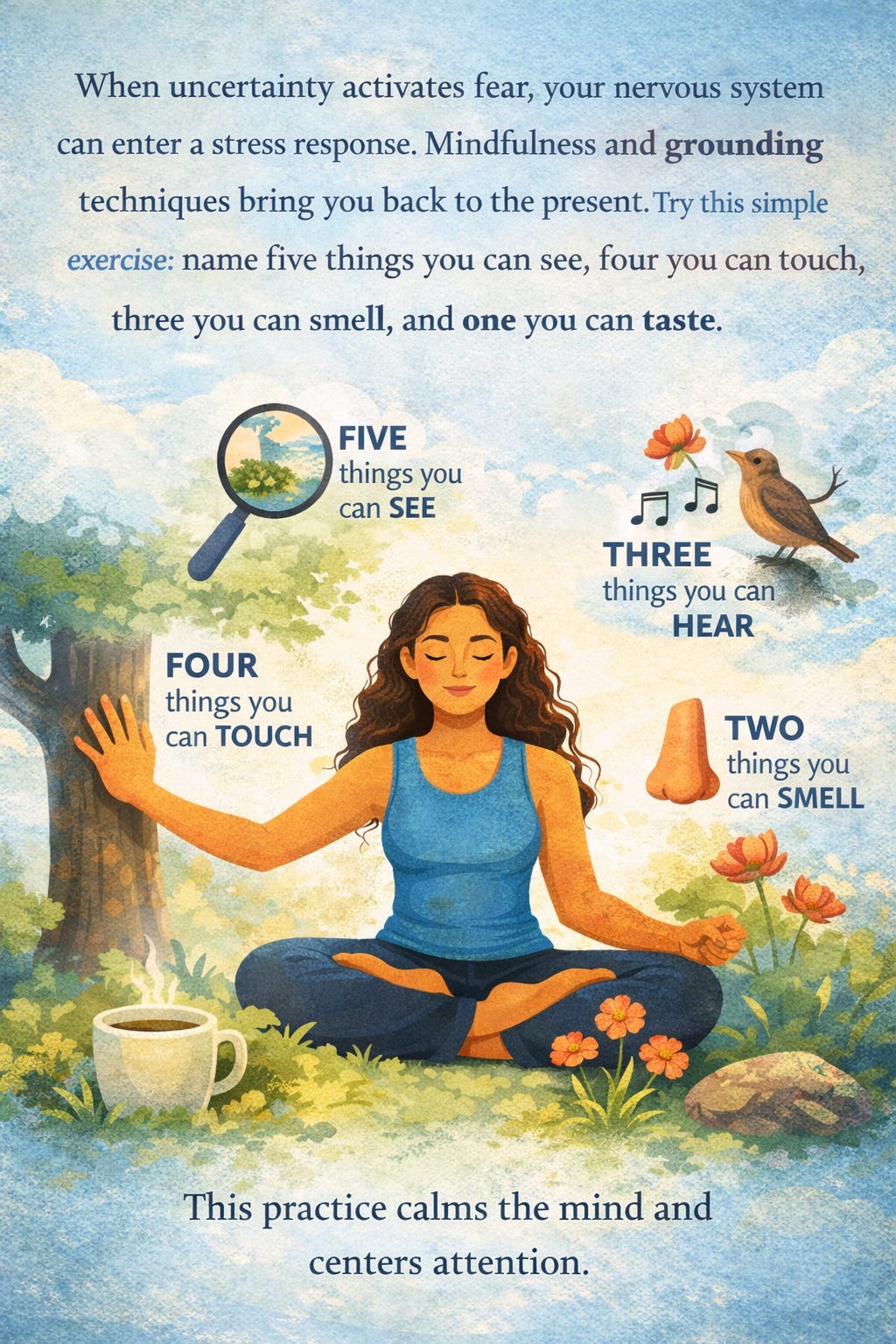
When uncertainty activates fear, your nervous system can enter a stress response. Mindfulness and grounding techniques bring you back to the present. Try this simple exercise: name five things you can see, four you can touch, three you can hear, two you can smell, and one you can taste. This practice calms the mind and centers attention.
5. Create Predictable Routines
Routines offer stability in uncertain times. Even small rituals—making coffee in the morning, walking at the same time each day, journaling before bed—can provide structure and reassurance. When much feels unknown, daily rhythms serve as anchors.
6. Cultivate Flexibility and Curiosity
Uncertainty often provokes resistance—“Why is this happening?” or “This shouldn’t be happening.” Instead, try shifting into a stance of curiosity. Ask: “What’s unfolding here?” or “What can I learn from this?” Flexibility doesn’t mean passivity; it means staying open to new responses as situations change.
7. Stay Connected
Uncertainty can be isolating. Talking with a friend, coach, or therapist helps you process what you’re experiencing and reminds you that you’re not alone. Social support doesn’t eliminate uncertainty, but it softens its emotional impact.
8. Take Care of Your Body
The mind and body are deeply connected. Sleep, nutrition, movement, and hydration all affect how we respond to stress. When uncertainty hits, self-care often falls by the wayside—but that’s precisely when it’s most needed. Even gentle movement or a nourishing meal can shift your internal state.
9. Give Yourself Permission Not to Know
You don’t have to figure everything out right now. Some situations simply require time, patience, or more information. Tolerating uncertainty is a skill that grows with practice. Try reminding yourself: “I don’t have to know yet. It’s okay to be in the middle.”
10. Scenario Planning
Imagine several possible futures and sketch out responses to each. If one seems the most plausible, flesh it out as completely as possible. If one seems the most desirable, visualize it happening.
11. Break Problems into Steps
Reduce big unknowns into smaller, manageable decisions. Describe each small step as clearly and concretely as you can.
12. Reconnect with Meaning and Purpose
Uncertainty often invites us to return to what matters most. What values guide you? What kind of person do you want to be, even in this uncertain time? Acting from purpose—whether it’s creativity, kindness, service, or growth—gives you a stable ground to stand on when outcomes are unclear.
Uncertainty may never feel comfortable, but it can become more manageable. These strategies won’t remove the unknown, but they will help you meet it with greater calm, clarity, and resilience. When you learn to cope well with uncertainty, you develop not just a survival skill—but a life skill.
More next week!
[I hope that you’re enjoying this series. Please check out the Noble Manhattan Existential Wellness Coach Certificate Program and my latest books, Brave New Mind and Night Brilliance.]
Check out Eric Maisel’s transformative courses in collaboration with Noble Manhattan—designed to elevate your coaching journey.

Each week Eric Maisel provides tips on the coaching life. Come to take a look at his three programs with Noble Manhattan Coaching: a Creativity Coach Certificate Program, an Existential Wellness Coach Program and a Relationship Coach Certificate Program.
You can subscribe to Dr. Maisel’s weekly newsletter here, visit him at his site here, and purchase his new resource for coaches, The Exceptional Coach, here.
Get your copy today!