Weekly Coaching Tip: A Brief History of My Work
The Search for Ethical Alignment in the Working World

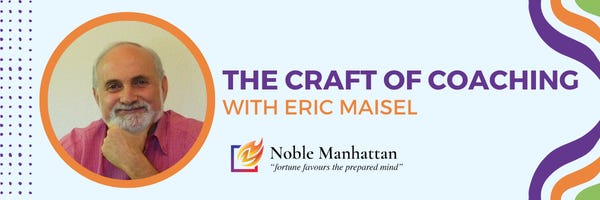
[Throughout the first half of 2026, I hope to provide you with a robust picture of how existential wellness coaches work with their clients on fundamental existential issues. If you’d like to learn more about the Noble-Manhattan Existential Wellness Coaching Certificate Program that I’ve developed, please visit here. There are scholarships available and all of the resources of the Noble Manhattan family. Come take a look. Today’s offering is Part 3 of a mini-series on work as an existential problem. Enjoy!]

Growing up with my mom in Brooklyn, I already had some sense of “my work,” which back then had to do with physics and math, on the one hand, and literature and philosophy, on the other. I had no job, of course (except for working at my in-laws’ antique store for parts of a few summers during high school), but I somehow felt “gainfully employed” reading Newton, Einstein, Sartre and Camus. All that “felt meaningful.”
College did not feel meaningful, and I flunked out. So, I joined the Army (during the Vietnam War). After I got out of the Army and graduated from college (with a degree in philosophy), I briefly worked for the Veterans Administration as a veterans’ benefits counselor. Veterans would come into the office with their concerns and questions and we counselors tried to help them.
I saw one veteran after another. In my naiveté, I thought that the idea was to help each veteran expeditiously and to then get right on to the next needy veteran. I did this for about a day-and-a-half before I was summoned into my supervisor’s office.
He explained to me that I was seeing too many veterans and making everyone else look bad. I had to slow down. I had to slow down a lot. His message was perfectly clear. I would not survive my probationary period if I kept working this fast.
That didn’t sit so well with me. Soon I left.
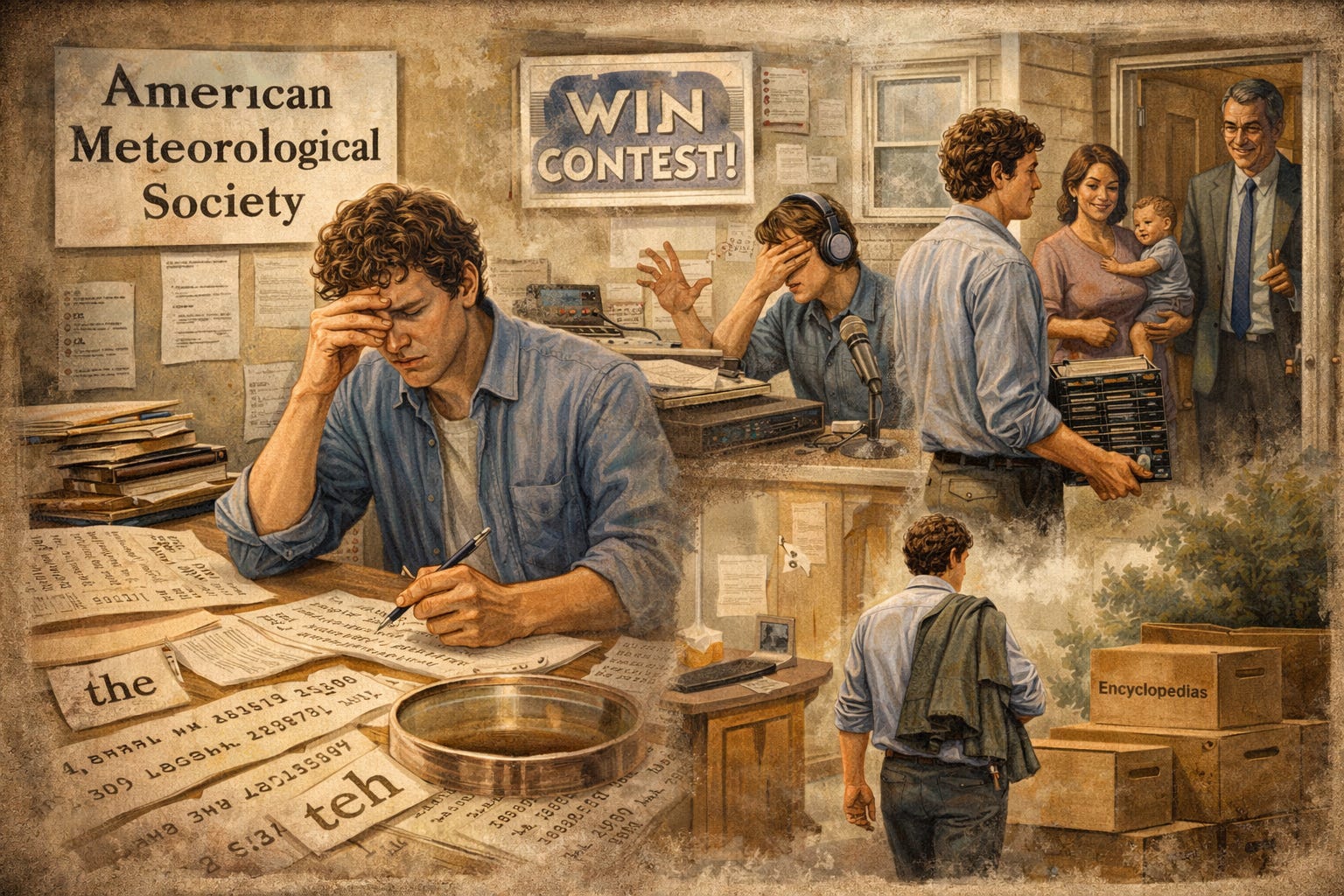
Next, I talked my way into a job as a proofreader at the American Meteorological Society. I had never previously done any proofreading but I crammed, learned a few symbols, passed a test, and got hired.
The challenge with this job was that it was stupendously, mind-numbingly boring. It wasn’t just dealing with paragraph after paragraph of jargon-drenched minutia that addled the brain. It was also that, as a double-check, we were to read each line backwards, to catch any last errors. Can you conceive of that?
Backwards! Yes, you might indeed discover that a “the” had been spelled “teh.” But what sort of salary would it take to allow you to sit there, straining your eyes and your nerves for forty hours a week, scanning lines backwards? More than they were paying. More than anyone could pay.
Then, through a friend of a friend, I got an odd job “judging contests.” I would travel around the country to radio stations and “officially” select the winner of the contest that the station was running. The prize was typically some up-and-coming band appearing at a local high school prom.
I’d cover my eyes and pluck a name out of a bowl. I’d show the deejay the prospective “winning” entry and, as often as not, he’d shut our mikes and whisper something like, “It can’t be a junior high school kid. Pick again!”
So, I would pick again. And maybe pick again, until we got to the “perfect” winner. I’m sure that that repeated picking wasn’t the worst sin the world has ever seen. You and I could both name graver ones. But I couldn’t do that job for very long, either.
Then I sold encyclopedias door-to-door. I memorized the pitch and went out with my trainer. It was instantly clear to me that the poor folks I was pestering shouldn’t buy the overpriced encyclopedia set I was hawking. One evening of doing that and I was done.

Then, through some fortunate connections, I got a writer’s dream job. I started ghostwriting. I loved writing and I loved being paid for writing. Indeed, it met a great many of the criteria for ideal work. Except, unfortunately, the ethical.
First, someone else’s name would appear on each of these books for hire. Did it matter that readers thought they were getting a book written by Joe or Jane? That probably wasn’t such a giant fraud. But weren’t readers being duped just a little?
But was it really proper to, for example, write a book about “the best singles’ bars in America” without visiting any? (I used Chamber of Commerce handouts.) Well, who was I hurting by sending folks to some well-liked fern bar in Houston? But still.
More tellingly, was it okay to write an arthritis guide when I knew nothing about arthritis? This well-paid one I just couldn’t make myself do. Instead, I handed it off to a friend, who tackled it gleefully, creating a book’s worth of made-up arthritis cures.
Then there was the book about biorhythms. I was asked to confer the mantle of research on some very dubious ideas about human rhythms promulgated by Wilhelm Fliess, an eye-ear-nose-and-throat doctor and Freud’s cocaine connection.
I did the research, wrote the book, debunked Fliess, and said some sensible things about biorhythms. The book appeared, carrying the name of a well-known clinical psychologist—and turning around everything that I had said about Fliess.
Well, that was it for ghostwriting. It was perfect work, but dubious. I mourned the loss of that wonderful writer’s gig, one that was allowing me to write my novels, and faced once again the need to acquire that ravenous eater of life and time, a job.
So, I went into training to become a psychotherapist. I found it curious that, after not so many classes, very few of which prepared us to do anything in particular, we were supposed to be able to “diagnose and treat mental disorders.” Amazing!
It was clear to me that my peers loved calling the folks they saw “patients,” as if they, my peers, were surgeons. I knew that something fishy was afoot and I’ve spent the last thirty-five years writing about the serious shortcomings of psychiatry and psychotherapy.
I could go on. And, if I asked you, you could go on, too. It isn’t just that work is “hard.” It’s that so much of work doesn’t sit well with us, psychologically, existentially, or ethically. Work is solidly embedded in a world of tedium, bottom lines, difficult personalities, dubious ethics and contentious mini-dramas—and who needs that?
But there are those bills to pay …
All of this an existential wellness coach knows all too well. And so, how might an existential wellness coach work with clients whose paid work falls far short of serving their meaning needs? Let’s look at that next week!
[I hope that you’re enjoying this series. Please check out the Noble Manhattan Existential Wellness Coach Certificate Program and my latest books, Brave New Mind and Night Brilliance.]
Check out Eric Maisel’s transformative courses in collaboration with Noble Manhattan—designed to elevate your coaching journey.

Each week Eric Maisel provides tips on the coaching life. Come to take a look at his three programs with Noble Manhattan Coaching: a Creativity Coach Certificate Program, an Existential Wellness Coach Program and a Relationship Coach Certificate Program.
Get your copy today!