Weekly Coaching Tip: Learning to Ask Yourself Better Questions
How reframing your internal dialogue shifts the mind from judgment to curiosity, breaks the loop of rumination, and unlocks personal agency.

[During the spring and summer of 2026 I’ll be presenting a series of posts on the art and practice of self-coaching. I think you’ll find this series valuable for your own purposes; and, if you work with clients, in your work with clients. Please enjoy! You can always reach me with comments and questions at ericmaisel@hotmail.com]
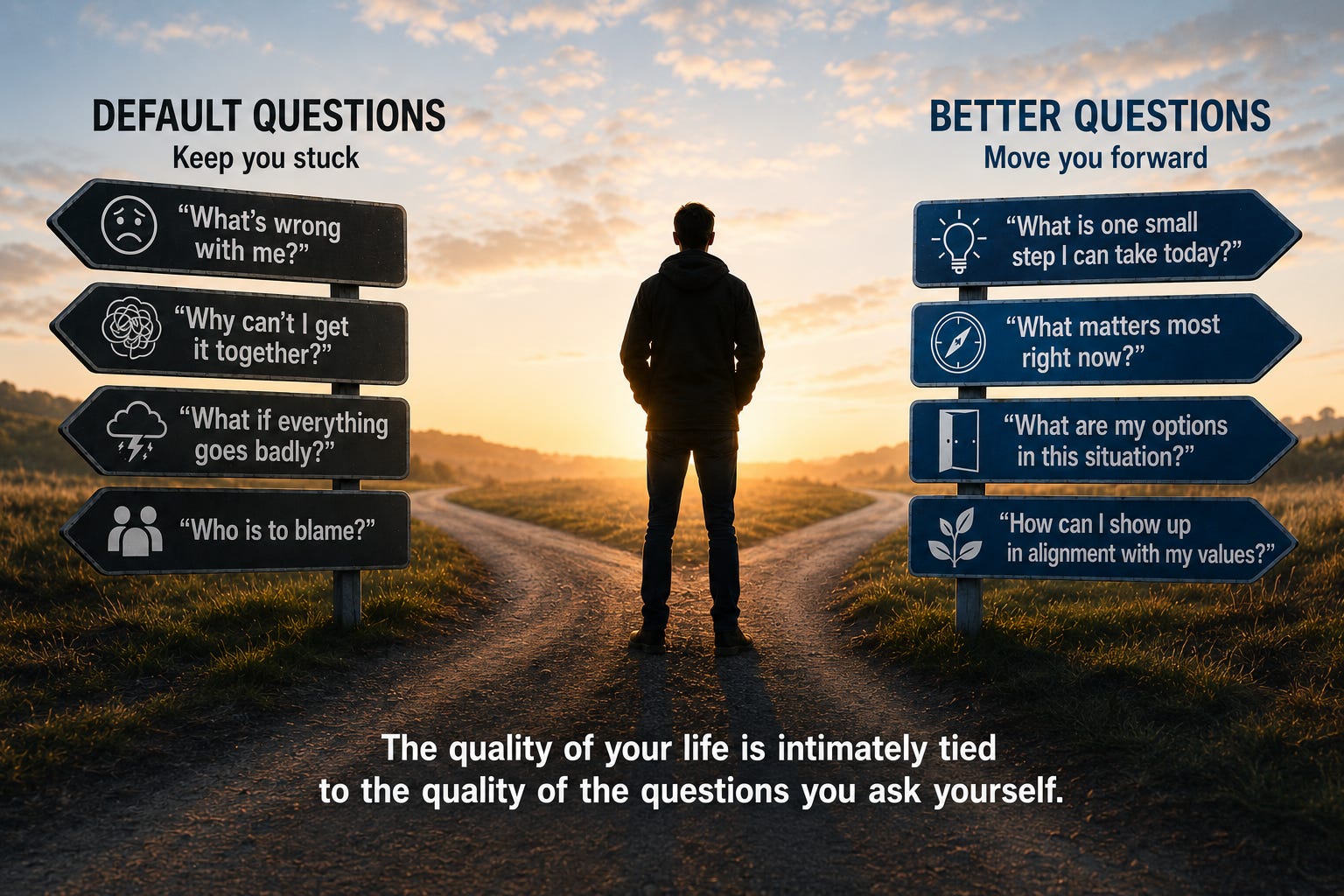
In self-coaching, the quality of your life is intimately tied to the quality of the questions you ask yourself. Most people do not recognize this. They assume that change comes from better answers—more insight, more knowledge, more advice. But in practice, answers tend to follow the path laid down by questions. If the question is narrow, reactive, or distorted, the answer will be too. If the question is expansive, honest, and well-aimed, the answer has a chance of being useful, even liberating.
To learn to ask yourself better questions is to begin to take charge of your own thinking.
The Problem with Default Questions
Left to its own devices, the mind asks predictable questions—many of them unhelpful. These questions are often shaped by fear, habit, and cultural conditioning. You might notice yourself asking:
“What’s wrong with me?”
“Why can’t I get it together?”
“What if everything goes badly?”
“Who is to blame?”
These questions feel natural because they arise automatically. But they tend to produce answers that reinforce distress. “What’s wrong with me?” leads to a list of perceived flaws. “Why can’t I get it together?” suggests that you should already have done so and invites self-criticism. “What if everything goes badly?” rehearses catastrophe. “Who is to blame?” narrows your attention to fault rather than possibility.
Default questions are not neutral. They actively shape your emotional life. One of the first tasks in self-coaching is to notice your default questions and to challenge their usefulness. Not all questions deserve to be entertained simply because they appear.
The Shift from Judgment to Curiosity
Better questions often involve a shift in tone—from judgment to curiosity. Compare these two approaches:
Judgmental: “Why am I so lazy?”
Curious: “What’s making it hard for me to start today?”
The first assumes a negative identity (“lazy”) and locks you into defending or attacking that identity. The second opens a space for investigation. It suggests that there are conditions, factors, or obstacles worth understanding.
Curiosity does not mean indulgence. It does not mean excusing yourself from responsibility. Rather, it means approaching your experience with enough openness that you can actually learn something about it.
Curious questions tend to be more specific, more situational, and more actionable. They invite you into a relationship with your own experience rather than into a verdict about it.
The Power of Reframing
A core self-coaching skill is the ability to reframe a question—to take an unhelpful question and transform it into a more useful one.
For example:
“Why is this happening to me?”
→ “Given that this is happening, what are my options?”“What if I fail?”
→ “What would failure actually look like, and how would I respond?”“Why don’t they appreciate me?”
→ “What do I need, and how can I express it clearly?”
Reframing does not deny reality. It accepts reality but changes your orientation to it. Instead of asking questions that trap you in helplessness or resentment, you ask questions that move you toward agency and clarity.
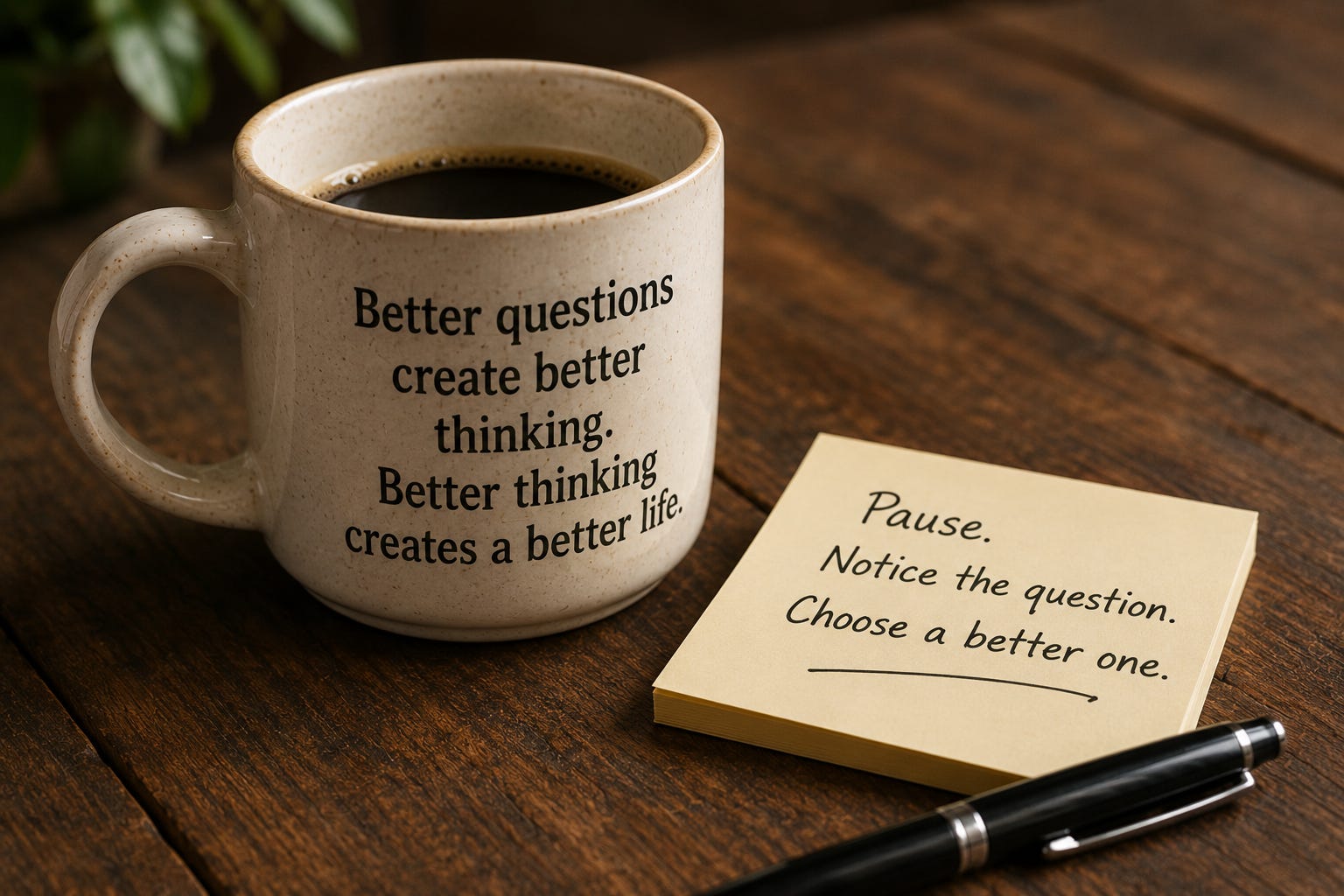
This is not always easy. The original question often carries emotional weight. But with practice, you can learn to pause, notice the question you are asking, and deliberately choose a better one.
Asking Questions That Lead to Action
Some questions lead to rumination. Others lead to action.
Rumination questions tend to circle endlessly:
“Why am I like this?”
“What’s wrong with my life?”
“Why does this always happen?”
These questions rarely produce satisfying answers. They keep you in a loop of analysis without movement.
Action-oriented questions, by contrast, point toward next steps:
“What is one small thing I can do today?”
“What matters most right now?”
“What would make this situation slightly better?”
The goal is not to eliminate reflection but to balance it with movement. A good self-coaching question often contains an implicit invitation to act.
Even a modest action can interrupt a cycle of rumination. When you ask, “What is one thing I can do?” you shift from passive analysis to active engagement with your life.
Honoring Complexity Without Losing Direction
Human experience is complex. Your thoughts, emotions, history, and circumstances intertwine in ways that are not easily disentangled. Better questions respect this complexity without becoming paralyzed by it.
For instance:
“What are all the factors contributing to how I feel right now?”
“Which of these factors can I influence, and which can I not?”
“Where do I want to place my attention and effort?”
These questions acknowledge that your situation is layered. At the same time, they help you orient yourself within that complexity. They invite discernment—an essential skill in self-coaching.
Not every problem can be solved immediately. But you can always ask a question that clarifies where you stand and what is possible next.
The Role of Values and Meaning
Better questions often reconnect you with your values and your sense of meaning.
In moments of confusion or distress, it is easy to lose sight of what matters to you. Your thinking becomes reactive, focused on discomfort rather than direction.
Questions such as these can help:
“What kind of person do I want to be in this situation?”
“What matters to me here, beyond my immediate feelings?”
“If I were acting in alignment with my values, what would I do?”
These are not easy questions. They do not produce quick answers. But they bring depth to your self-coaching. They remind you that your life is not just a series of problems to solve but a series of choices about how to live.
Practicing Better Questioning
Learning to ask better questions is a practice. It requires repetition, patience, and a willingness to experiment.
You might begin by setting aside a few minutes each day to reflect on a current challenge and to deliberately generate better questions. Write them down. Notice which ones open something up and which ones shut things down.
You can also catch yourself in the moment. When you notice a distressing thought, ask: “What question am I asking right now?” Then consider: “Is this the best question I could be asking?”
Over time, this becomes more natural. You begin to internalize a different style of thinking. Your mind becomes less of an adversary and more of a collaborator.
Becoming Your Own Questioner
At its heart, self-coaching is about becoming your own thoughtful questioner. Instead of waiting for someone else to guide your thinking, you take on that role yourself.
This does not mean that you will always have the perfect question. You will still fall into old patterns. You will still ask unhelpful questions. But you will also have the capacity to notice, to adjust, and to try again.
Better questions do not guarantee easy answers. But they create the conditions for more honest, more useful, and more life-affirming responses.
And in the long run, that is what self-coaching is about: not having all the answers, but learning how to think in ways that support the life you want to live.
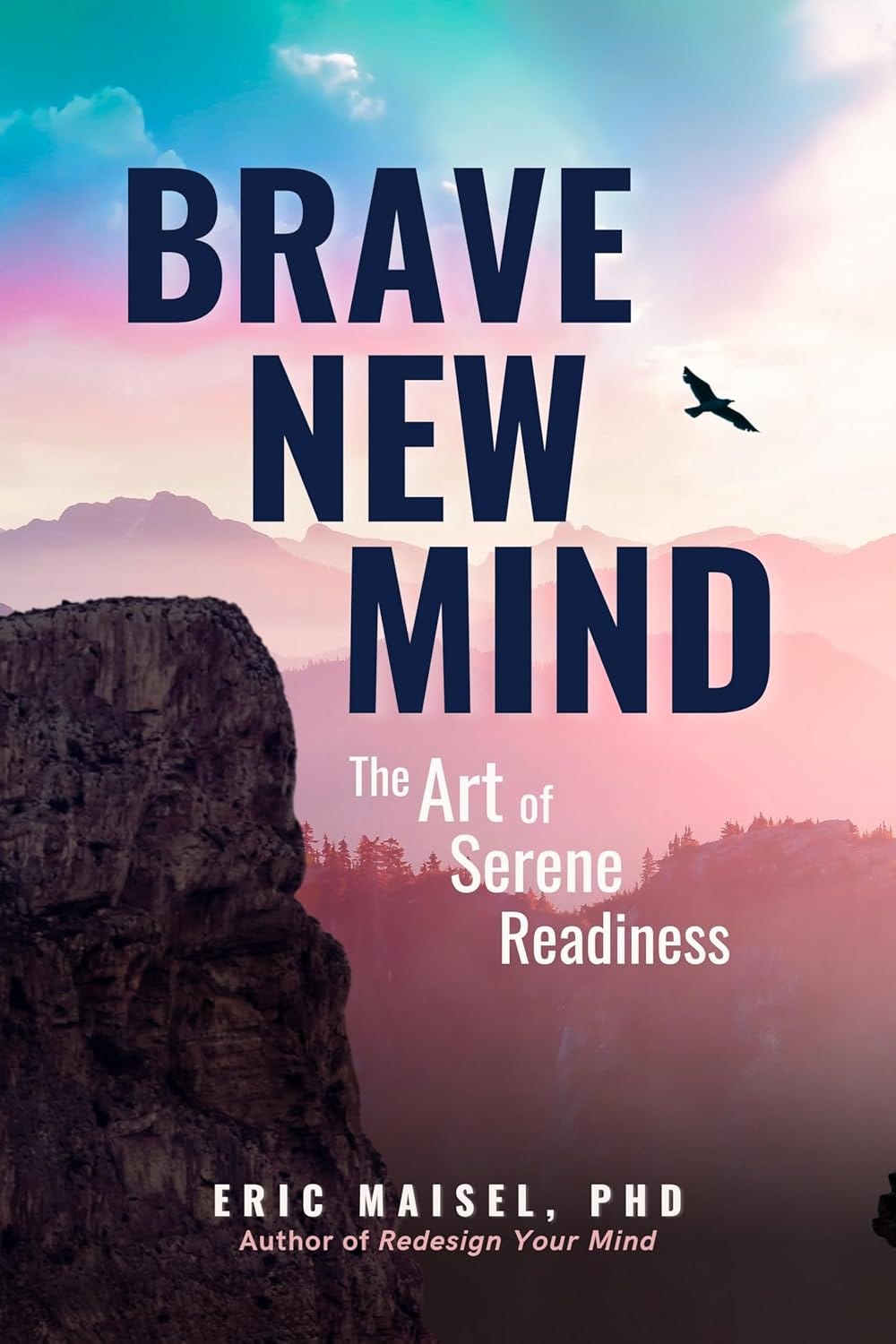
[I hope that you’re enjoying this series. Please check out the Noble Manhattan Existential Wellness Coach Certificate Program and my latest books, Brave New Mind and Night Brilliance.]
Check out Eric Maisel’s transformative courses in collaboration with Noble Manhattan—designed to elevate your coaching journey.

Each week Eric Maisel provides tips on the coaching life. Come to take a look at his three programs with Noble Manhattan Coaching: a Creativity Coach Certificate Program, an Existential Wellness Coach Program and a Relationship Coach Certificate Program.
You can subscribe to Dr. Maisel’s weekly newsletter here, visit him at his site here, and purchase his new resource for coaches, The Exceptional Coach, here
GET YOUR COPY TODAY!
With Brave New Mind, Eric Maisel delivers a compelling and timely guide for navigating mental health in our anxiety‑fueled age. Its blend of clarity, depth, and usable tools creates a powerful toolkit—not just for surviving stress, but for forging a more calm, purposeful, and resilient way of living.
It’s not about seeking escape; it’s about crafting a mind equal to the demands of today. If you’re ready to face fear, anxiety, and uncertainty with presence and meaning, this is a book to lean into.