
Weekly Coaching Tip: The Knowable and the Not
Navigating the Threshold

[Throughout the first half of 2026, I hope to provide you with a robust picture of how existential wellness coaches work with their clients on fundamental existential issues. If you’d like to learn more about the Noble-Manhattan Existential Wellness Coaching Certificate Program that I’ve developed, please visit here. There are scholarships available and all of the resources of the Noble Manhattan family. Come take a look. Today’s offering is Part 6 of a mini-series on ambiguity and uncertainty, two issues with which your clients are unquestionably wrestling.]
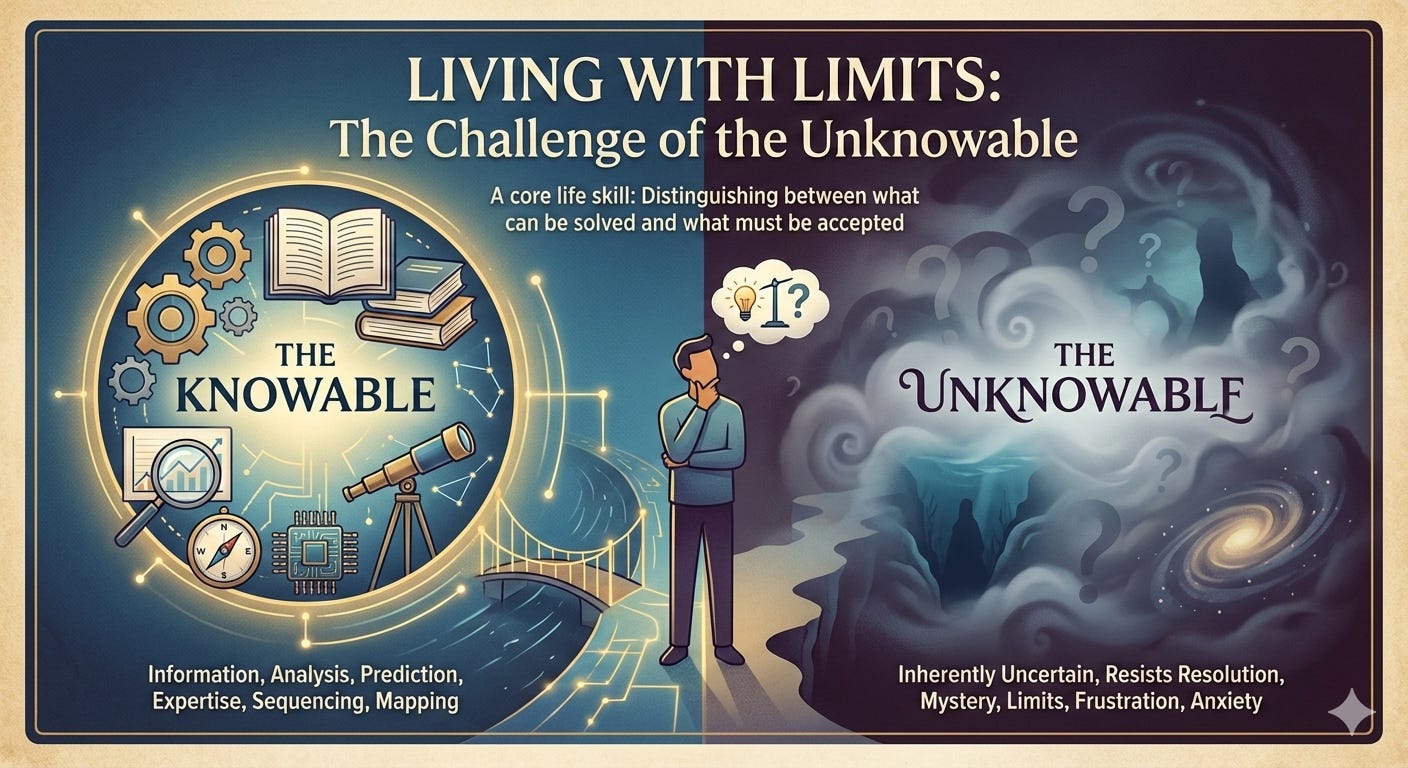
One of the great challenges of being human is learning to live with limits—especially the limits of what we can know.
In a world that prizes information, analysis, and prediction, we often assume that with enough effort or expertise, anything can be known. But this assumption leads to frustration, confusion, and anxiety when we inevitably bump into situations that resist resolution. A core life skill, then, is learning to distinguish between what is knowable and what is not.
This distinction is not always easy or obvious. We live in a time when knowledge is expanding exponentially. We can sequence genomes, map the ocean floor, and predict weather with remarkable accuracy. In science and technology, many things that once deemed unknowable have come within reach. But even the most brilliant scientists understand that some phenomena remain inherently uncertain.
Quantum mechanics, for example, teaches us that particles behave unpredictably at a subatomic level. The Heisenberg Uncertainty Principle shows that we cannot simultaneously know both the position and momentum of a particle with precision. In other words, limits to knowledge are built into the very fabric of reality.
In the realm of human affairs, the line between the knowable and the unknowable becomes even more significant—and more personal. We can know the facts of a situation, but not always the motives of others. We can know what happened, but not always why it happened. We can know how we feel today, but not how we’ll feel tomorrow. We can plan, but we cannot predict with certainty how things will unfold.
Practically speaking, distinguishing the knowable from the unknowable can bring tremendous relief. In a moment of decision-making, we can ask: What do I truly know? What am I assuming? What remains unclear no matter how much I think about it?
For example, we may know that a job offer meets our financial needs and interests. But we cannot know whether we’ll thrive in that company’s culture. We may know that we love someone deeply, but we cannot know whether the relationship will last. Acknowledging what we don’t or can’t know helps us make decisions realistically rather than romantically.
This discernment also cultivates humility, patience, and faith—not necessarily religious faith, but a kind of existential trust. Trust in our ability to respond to the unknown. Trust that some truths emerge over time. Trust that not knowing is not a failure but a fact of life. When we stop demanding certainty where none exists, we make room for other kinds of clarity: clarity about what matters, what we value, what we’re willing to risk.

We become better listeners, more honest decision-makers, and less reactive in the face of uncertainty. Ultimately, the line between the knowable and the unknowable is not a wall—it’s a threshold. And learning to stand there, eyes open, is a mark of true wisdom.
More next week!
[I hope that you’re enjoying this series. Please check out the Noble Manhattan Existential Wellness Coach Certificate Program and my latest books, Brave New Mind and Night Brilliance.]
Check out Eric Maisel’s transformative courses in collaboration with Noble Manhattan—designed to elevate your coaching journey.

Get your copy today at Bookshop/Indie Bound, Indigo, Amazon, and Barnes & Noble
I was listening to a YouTube video by Andre Rabi yesterday on the nature of reality, and he quoted Heisenberg and the Uncertainty principle. He created three videos; physics, philosophy and theology, and entwined the disciplines into one coherent context.
I'm finding that my favourite content creators are starting to link up in their ideas.
Thank you for all of the work that goes into your account 💜.
Thank you, there was a poem partly brewing and this has helped me to crystallise it 💜.