Weekly Coaching Tip: Triggered By Uncertainty
Stop Being Controlled by Uncertainty—Start Being in Conversation with It


[Throughout the first half of 2026, I hope to provide you with a robust picture of how existential wellness coaches work with their clients on fundamental existential issues. If you’d like to learn more about the Noble-Manhattan Existential Wellness Coaching Certificate Program that I’ve developed, please visit here. There are scholarships available and all of the resources of the Noble Manhattan family. Come take a look. Today’s offering is Part 7 of a mini-series on ambiguity and uncertainty, two issues with which your clients are unquestionably wrestling.]
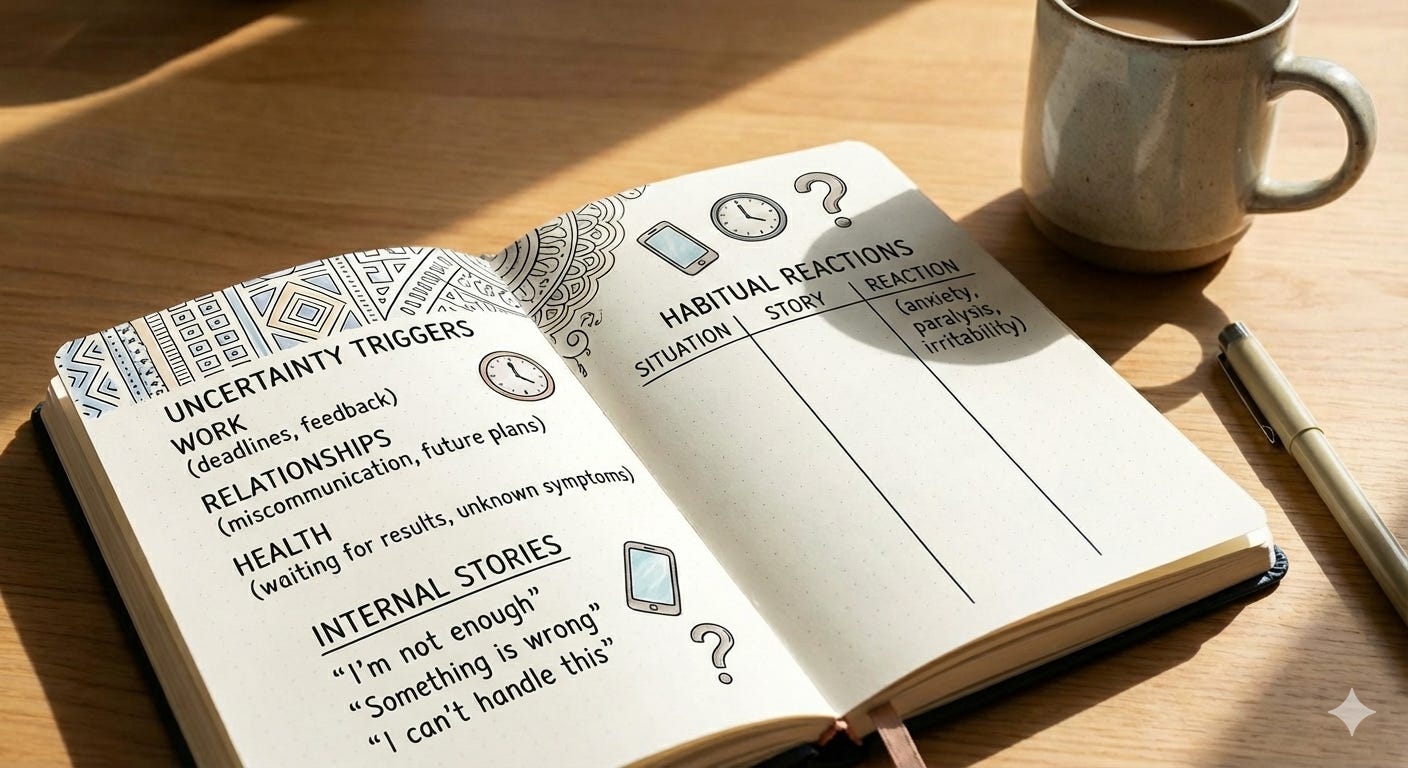
Uncertainty is a universal part of life—but not everyone responds to it in the same way. For some, uncertainty sparks curiosity or creative energy. For others, it provokes anxiety, irritability, or paralysis. Our reactions to uncertainty are often shaped by deeper beliefs, past experiences, and psychological patterns.
One powerful way to increase resilience and self-awareness is by learning to track our personal triggers around uncertainty—to notice what kinds of situations provoke disproportionate stress, what internal stories accompany that stress, and how we habitually react.
A “trigger” is anything that sets off a strong emotional response. When it comes to uncertainty, triggers often appear in moments when the future is unclear, when outcomes are out of our control, or when we’re asked to make a decision without having all the information we want.
These situations might include waiting for medical test results, not knowing how someone feels about us, navigating financial instability, or facing career transitions. What’s triggering for one person may feel completely manageable to another—so tracking our individual responses becomes a deeply personal process.
The first step is noticing the pattern. When uncertainty arises, how does your body respond? Do you feel tightness in your chest? A spike in heart rate? A knot in your stomach? Physiological reactions are often the first clue that something is being triggered.
Then, what thoughts arise? Do you move into worst-case scenarios, judgment, or self-blame? Do you try to take control, seek reassurance, or avoid the situation entirely? These responses are not flaws—they are learned strategies for managing discomfort. But they can become limiting if they’re left unchecked.
For example, someone with a childhood history of unpredictability—perhaps due to inconsistent parenting or chaotic environments—may be especially sensitive to uncertainty in adult life. Even small unknowns, like a delayed email or a last-minute schedule change, may set off a cascade of anxious thoughts. The emotional reaction isn’t just about the current situation; it’s a residue of past experiences. Tracking these moments helps bring that history to light, allowing for healing and growth.
To track your triggers around uncertainty, consider keeping a journal specifically devoted to this inquiry. Each time you notice a stress response, write down:
What happened? (the external event)
What did I feel? (physically and emotionally)
What did I think? (automatic thoughts, assumptions, fears)
What did I do? (actions taken or avoided)
What might this connect to? (earlier experiences, core beliefs)
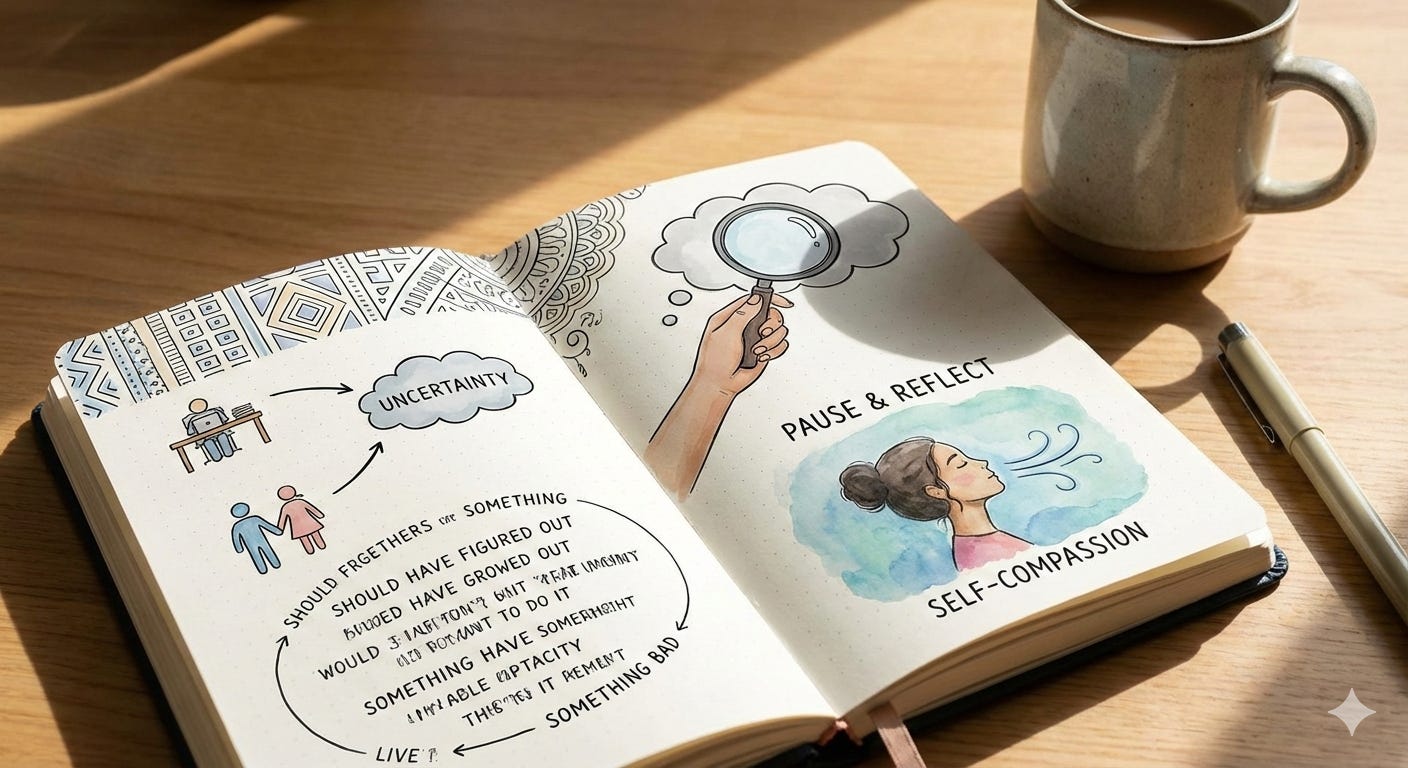
Over time, patterns will emerge. You may discover that uncertainty in relationships is more triggering than uncertainty at work—or vice versa. You may see that certain thought loops (e.g., “I should have this figured out by now” or “Something bad is going to happen”) consistently amplify your distress. With this insight, you can begin to interrupt the cycle—not by forcing yourself to be comfortable with uncertainty overnight, but by responding more consciously.
The ultimate goal of tracking triggers is not to eliminate them but to build a different relationship to them. Once we understand our reactions, we can choose to pause rather than to panic. We can ground ourselves with self-compassion, remind ourselves of past resilience, or reframe the situation in more helpful ways. We might ask, “What part of me is afraid right now?” or “What would it look like to stay with this question a little longer?”
In existential wellness coaching, helping clients track their triggers around uncertainty can be a key step toward emotional freedom. By shining a light on hidden patterns, we reduce their power. By naming them, we make room for different choices. Over time, what once felt intolerable can become merely uncomfortable—and eventually, just part of the landscape.
Uncertainty may always bring some level of discomfort. But when we track our triggers, we begin to shift from being controlled by them to being in conversation with them. That shift—from reaction to reflection—is where resilience begins.
More next week!
[I hope that you’re enjoying this series. Please check out the Noble Manhattan Existential Wellness Coach Certificate Program and my latest books, Brave New Mind and Night Brilliance.]
Check out Eric Maisel’s transformative courses in collaboration with Noble Manhattan—designed to elevate your coaching journey.

Each week Eric Maisel provides tips on the coaching life. Come to take a look at his three programs with Noble Manhattan Coaching: a Creativity Coach Certificate Program, an Existential Wellness Coach Program and a Relationship Coach Certificate Program.
You can subscribe to Dr. Maisel’s weekly newsletter here, visit him at his site here, and purchase his new resource for coaches, The Exceptional Coach, here
Now Available!